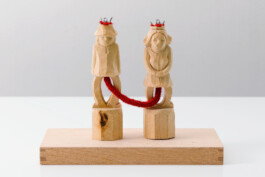
Gabriela Oberkofler – Verstrickt, 2006
Sara Fegg
A thread—between cohesion and entanglement.
In her woodcarving “Verstrickt” (2006), Bolzano-born artist Gabriela Oberkofler—who studied at the State Academy of Fine Arts in Stuttgart from 2002 to 2009—playfully explores this ambivalence. Two carved wooden figures stand side by side, inextricably linked by a red, knitted cord. What at first glance resembles a harmless handicraft made by two knitting dolls unfolds as a multi-layered reflection on connection, the body, and the cultural meanings of closeness.
The carving was produced in an edition of five copies plus one artist’s copy—the copy held by the MWK is numbered 1/5+1. The small sculptural work (20 × 13 × 6 cm) was acquired in 2011 to mark the 60th anniversary of the state of Baden-Württemberg.
The work depicts two stylized figures, one female and one male, which also function as knitting dolls. Their heads are fitted with metal hoops, as is typical of this type of handicraft. Both bodies are hollow from the head down to the lower abdomen, and a red, knitted cord runs through this opening, connecting the figures to one another. It is striking that there is neither a ball of yarn nor a visible end of the thread. The connection between the two figures therefore appears to be inseparable. The figures’ slightly bent legs allow the cord to emerge from the lower abdomen and, at the same time, lend the depiction a subtle sense of physicality.
Oberkofler’s work is closely linked to her early biographical experiences in a strictly Catholic, rural environment. The ambivalence of blood as both a material substance and a religiously charged vehicle of meaning recurs repeatedly in her work—for example, in the context of the Eucharist, where blood is both a real substance and a transcendent symbol. Against this backdrop, the red cord in “Verstrickt” can be interpreted as a bloodstream flowing through both bodies and existentially connecting them. The figures thus appear to be entangled not only physically but also genealogically and culturally—an interpretation that suggests associations with family, origin, or romantic relationships. At the same time, the red cord emerging from the area of the body orifices with sexual connotations creates a deliberate sense of unease, as it inevitably evokes associations with menstruation and childbirth and adds a dimension of generative, physical transmission to the connection between the figures. The craftsmanship of the carving, which evokes folk art traditions, reinforces this interpretive reading; however, Oberkofler conceptually subverts it by using the seemingly familiar to reveal its inner tensions. Whether interpreted as a parent-child relationship, a familial bloodline, or an intense bond between partners remains open to interpretation. It is precisely this ambivalence that reinforces the impression of a deeply ingrained connection running through “flesh and blood,” one that eludes clear categorization.
“Verstrickt” is thus a quiet, precise work about connection and dependence, about the body as a conduit for meaning—and about the fragility of the threads that bind people together.
Bibliography
AK, Baden-Württemberg 60. 60 Jahre Land Baden-Württemberg – 60 Kunstwerke für Baden-Württemberg, Städtisches Kunstmuseum Singen u.a., 29. Januar bis 11. März 2012.
AK, Desperate Housewives? Künstlerinnen räumen auf, Museum im Kulturspeicher Würzburg u.a., 20. Juni bis 20. September 2015.
AK, Gabriela Oberkofler – Blut im Schuh, Hospitalhof Stuttgart, 18. September bis 18. Oktober 2009.
AK, we love to entertain you, Städtische Galerie Villingen-Schwenningen, 14. Mai bis 16. Juli 2006.
Gabriela Oberkofler – Verstrickt, 2006
Sara Fegg
A thread—between cohesion and entanglement.
In her woodcarving “Verstrickt” (2006), Bolzano-born artist Gabriela Oberkofler—who studied at the State Academy of Fine Arts in Stuttgart from 2002 to 2009—playfully explores this ambivalence. Two carved wooden figures stand side by side, inextricably linked by a red, knitted cord. What at first glance resembles a harmless handicraft made by two knitting dolls unfolds as a multi-layered reflection on connection, the body, and the cultural meanings of closeness.
The carving was produced in an edition of five copies plus one artist’s copy—the copy held by the MWK is numbered 1/5+1. The small sculptural work (20 × 13 × 6 cm) was acquired in 2011 to mark the 60th anniversary of the state of Baden-Württemberg.
The work depicts two stylized figures, one female and one male, which also function as knitting dolls. Their heads are fitted with metal hoops, as is typical of this type of handicraft. Both bodies are hollow from the head down to the lower abdomen, and a red, knitted cord runs through this opening, connecting the figures to one another. It is striking that there is neither a ball of yarn nor a visible end of the thread. The connection between the two figures therefore appears to be inseparable. The figures’ slightly bent legs allow the cord to emerge from the lower abdomen and, at the same time, lend the depiction a subtle sense of physicality.
Oberkofler’s work is closely linked to her early biographical experiences in a strictly Catholic, rural environment. The ambivalence of blood as both a material substance and a religiously charged vehicle of meaning recurs repeatedly in her work—for example, in the context of the Eucharist, where blood is both a real substance and a transcendent symbol. Against this backdrop, the red cord in “Verstrickt” can be interpreted as a bloodstream flowing through both bodies and existentially connecting them. The figures thus appear to be entangled not only physically but also genealogically and culturally—an interpretation that suggests associations with family, origin, or romantic relationships. At the same time, the red cord emerging from the area of the body orifices with sexual connotations creates a deliberate sense of unease, as it inevitably evokes associations with menstruation and childbirth and adds a dimension of generative, physical transmission to the connection between the figures. The craftsmanship of the carving, which evokes folk art traditions, reinforces this interpretive reading; however, Oberkofler conceptually subverts it by using the seemingly familiar to reveal its inner tensions. Whether interpreted as a parent-child relationship, a familial bloodline, or an intense bond between partners remains open to interpretation. It is precisely this ambivalence that reinforces the impression of a deeply ingrained connection running through “flesh and blood,” one that eludes clear categorization.
“Verstrickt” is thus a quiet, precise work about connection and dependence, about the body as a conduit for meaning—and about the fragility of the threads that bind people together.
Bibliography
AK, Baden-Württemberg 60. 60 Jahre Land Baden-Württemberg – 60 Kunstwerke für Baden-Württemberg, Städtisches Kunstmuseum Singen u.a., 29. Januar bis 11. März 2012.
AK, Desperate Housewives? Künstlerinnen räumen auf, Museum im Kulturspeicher Würzburg u.a., 20. Juni bis 20. September 2015.
AK, Gabriela Oberkofler – Blut im Schuh, Hospitalhof Stuttgart, 18. September bis 18. Oktober 2009.
AK, we love to entertain you, Städtische Galerie Villingen-Schwenningen, 14. Mai bis 16. Juli 2006.